

The innovation, jointly developed in China, could reduce the threat the material poses in seas across the world.
Chilean businessman Roberto Astete has had the same dream for several years: used plastic cutlery from a dinner party is automatically sorted and fed into small grinders, after which the debris is dissolved in water in just a few minutes before being flushed away.
"We wouldn't need to collect, transport and dispose of plastic waste at special facilities anymore. It could be processed easily on-site to reduce ocean pollution," he said.
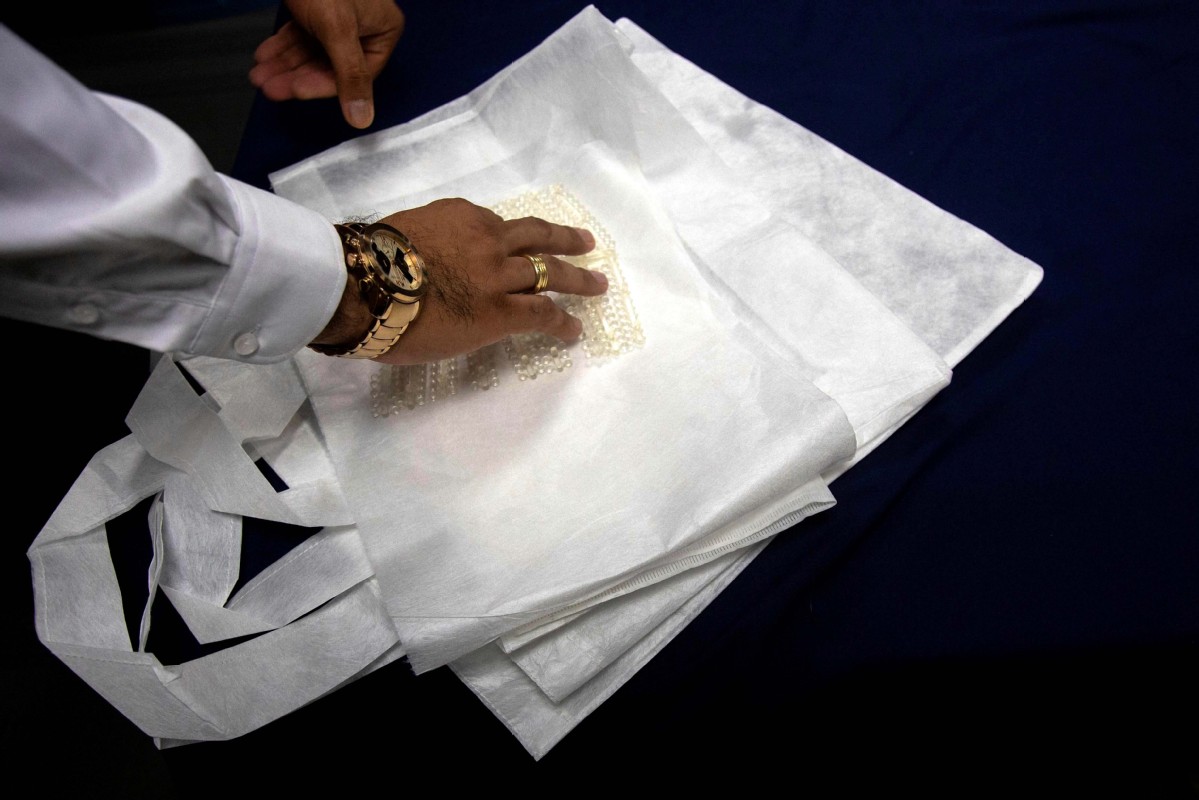
Bags made from PVA, a water-soluble material, are displayed at a media briefing in Santiago, Chile, in July. CLAUDIO REYES/FOR CHINA DAILY
Now, Astete's dream is almost a reality thanks to a new material and processing technology devised by his partner company in South China.?
In late July, Astete's company Solubag SpA and Polye Materials Co, in Guangdong province, jointly launched a series of soluble shopping bags in Santiago, capital of Chile, just before the Chilean government enacted a law that banned businesses from providing customers with free plastic bags.
It takes centuries for petrochemical plastic bags to degrade in the ocean-in the meantime they choke marine animals and harm the entire ecosystem.
The bag introduced by the two companies dissolves in water quickly, and Astete even drank the mixture during a press conference to endorse its safety.
According to Chen Gang, chairman of Polyrocks Chemical Co, Polye's parent company, the bag is made from modified polyvinyl alcohol, aka PVA, which comes from natural gas or calcium carbide.
"PVA bags dissolve in water in minutes so they won't choke marine animals. The solution will not pollute water or soil," Chen said. "This alternative to plastic bags is eco-friendly."
PVA has been used in paint, glue and textile manufacturing since the 1930s, and PVA film has also been widely used for packaging in recent years.
However, it was difficult and costly to process the material into shopping bags because of its lack of thermoplasticity (pliability when heated), said Cui Yuefei, the bag's inventor and a senior engineer with the South China University of Technology in Guangzhou, capital of Guangdong.
Cui spent years modifying PVA in laboratories and completed his experiments in 2008. By adding certain agents, he made it easier for the material to be pelleted, blow-molded and made into bags.
 |

 Award-winning photos show poverty reduction achievements in NE China's Jilin province
 People dance to greet advent of New Year in Ameiqituo Town, Guizhou
 Fire brigade in Shanghai holds group wedding
 Tourists enjoy ice sculptures in Datan Town, north China
 Sunset scenery of Dayan Pagoda in Xi'an
 Tourists have fun at scenic spot in Nanlong Town, NW China
 Harbin attracts tourists by making best use of ice in winter
 In pics: FIS Alpine Ski Women's World Cup Slalom
 Black-necked cranes rest at reservoir in Lhunzhub County, Lhasa
 China's FAST telescope will be available to foreign scientists in April